
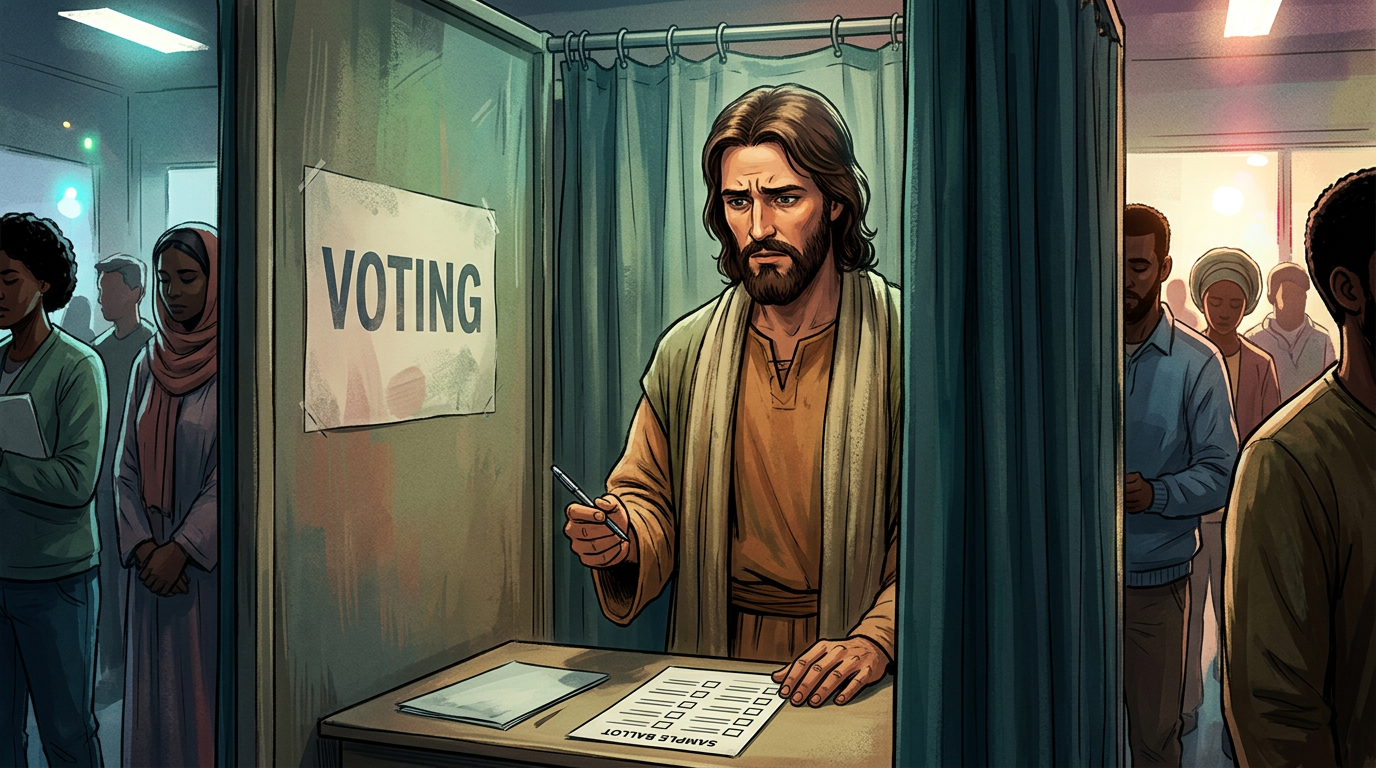
Every election year, evangelical leaders get red-faced and start claiming that you can’t vote for a Democrat or be a Democrat and also be a Christian. In fact, the line is so often repeated that many Christians foolishly believe it.
But is it truth?
Jesus was a Galilean Jew living under Roman occupation. America didn’t exist. Neither did the idea of America, the Constitution, a two-party system, a primary, a ballot, or a cable news panel of people yelling at each other in split screens. The first English colony in North America was about sixteen centuries away. Jesus never cast a vote, never endorsed a candidate, and never said a word about tax brackets, border policy, or judicial appointments in a country that would not exist for another 1,700 years.
That sounds like a joke, but it’s the whole argument in miniature. If a claim requires Jesus to have a position on a political party, the claim has to explain how he got one. Nobody ever does. They reach for a verse about something else and stretch it until it covers an election he never saw.
The parties are tiny and Jesus is not
Consider the scale. A political party is a coalition of people who agree on a bundle of policies, assembled for the purpose of winning elections. The bundle is not coherent. It’s negotiated. It includes whatever the donors, the activists, and the polls made necessary this decade. Parties switch positions on trade, on war, on government size, on immigration, sometimes within a single lifetime. The party your grandfather voted for may have stood for nearly the opposite of what its namesake stands for now.
Now compare that to Jesus, the person Christians say is the Son of God, the one through whom all things were made. Is that person really the property of one coalition of fundraisers? Either he is far bigger than Washington or he isn’t Lord of anything. You can’t have a Christ who is Lord of heaven and earth and also a reliable member of the platform committee.
Both parties, honestly, are stuck with the same problem. Each one gets some of Jesus right and a good deal of him wrong. A Christian who votes Republican should be uncomfortable with certain things. A Christian who votes Democratic should be uncomfortable with certain things. If you walk into the booth feeling perfectly comfortable, my gentle suggestion is that you haven’t read the red letters lately.
What Jesus actually talked about
Jesus talked constantly about one subject, and it wasn’t Rome, and it wasn’t Israel’s domestic policy. It was the kingdom of God, or the kingdom of heaven. He opened his public ministry announcing it was near. He told story after story about what it’s like. When his disciples asked him how to pray, he gave them a prayer that includes the line “on earth as it is in heaven.”
Read that again slowly, because it’s the thesis of his entire mission. He wasn’t teaching people how to escape the earth and he wasn’t teaching them how to run it. He was praying for heaven’s way of doing things, God’s way, to show up here. Mercy for the debtor. Food for the hungry. Welcome for the outsider. Forgiveness instead of score-keeping. Enemies loved instead of destroyed.
Notice what that does to politics. If the standard is “as it is in heaven,” then no earthly government ever clears the bar. Not Rome, not Jerusalem, not Washington. Every system falls short, which means every system is subject to the same judgment. That’s a deeply uncomfortable thing for a movement that wants to say its side is the Christian one.
What did Jesus do when he was asked about politics?
People tried to drag Jesus into politics all the time, and the way he handled it is instructive. When a trap was set about whether to pay the Roman tax, a question that would have made him an enemy of either the occupiers or the nationalists, he asked for a coin, asked whose face was on it, and told them to give Caesar what’s Caesar’s and God what’s God’s. He refused to join either camp. Both sides left annoyed.
When Pilate questioned him, he said his kingdom is not of this world. When the crowd tried to take him by force and make him king after he fed them, he walked away. Satan offered him every kingdom on earth in the wilderness, and he said no. Political power was on the table, offered to him directly, and he turned it down at the very beginning.
If the one person in history with the strongest claim to rule declined the job. Why would his followers think the best use of his name is to win it for a party?
The things you’d have to ignore
Here’s where it gets awkward for anyone who wants to claim Jesus for a single side. His teachings don’t sort neatly. Some of them land on what Americans call the left, some on the right, and plenty land on neither.
He told a rich man to sell what he had and give to the poor. He said the judgment of the nations turns on whether people fed the hungry, welcomed the stranger, clothed the naked, and visited the prisoner. He called peacemakers blessed. He told his followers to love their enemies and to turn the other cheek. He said it’s nearly impossible for the wealthy to enter the kingdom. A voter who cares about those things can reasonably look at the Democratic platform and see more overlap than elsewhere.
He also taught that even the smallest and most vulnerable lives mattered, welcomed children when others tried to turn them away, and spoke of marriage as a sacred union. A voter who prioritizes protecting unborn life and strengthening families can reasonably look at the Republican platform and find points of agreement.
The honest conclusion isn’t that Jesus split the difference. It’s that he doesn’t fit the grid at all. He judged the powerful and the self-righteous, defended the vulnerable, forgave sinners, and condemned hypocrisy, and he did all of it without a party affiliation. Christians of good faith look at the same teachings and weigh them differently when they vote. That’s not a failure of faith. It’s what happens when a first-century teacher gets applied to a twenty-first-century democracy.
So can a Christian vote Democratic?
Yes. Obviously yes. So can a Christian vote Republican, or independent, or write in a name, or decide that no candidate deserves it this year. The claim that one of those choices disqualifies you from the faith has no support in anything Jesus said. It’s a claim about politics wearing the costume of a claim about salvation.
Notice who benefits when the claim is believed. A party that can convince its voters that voting against the party means voting against God doesn’t have to earn their loyalty with good governance. The fear does the work. Jesus had a name for religious leaders who bound heavy burdens on people that God never asked them to carry. He called them hypocrites.
And look at what the claim costs the church. When Christianity gets fused to a party, every scandal of that party becomes a scandal of Christ in the eyes of outsiders. People who might have been drawn to the real Jesus see the political one, decide they want nothing to do with him, and walk away. A lot of people have been hurt by exactly this. They didn’t reject Jesus. They rejected the version they were handed, and frankly, they had a point.
Decouple them
The fix is simple to state and hard to do. Separate Christ from the campaign.
That doesn’t mean Christians should stay out of public life. Jesus cared about how people were treated, and a citizen in a democracy has a real say in that. Vote your conscience. Argue for what you think mercy and justice require. Run for office if you’re called to. But do it as a person shaped by Jesus, not as someone using Jesus as a weapon. Hold your politics loosely enough that you can admit you might be wrong, and hold your faith firmly enough that no election result can threaten it.
Whatever happens at the polls, the kingdom Jesus announced doesn’t rise or fall on a vote count. It wasn’t established by a government and no government can cancel it. His followers are asked to live it out, in how they treat the person in front of them, regardless of who won.
Jesus isn’t on the ballot. Go vote anyway, and then go love your neighbor, including the one who voted the other way.
Discover more from Jesus Quest
Subscribe to get the latest posts sent to your email.