
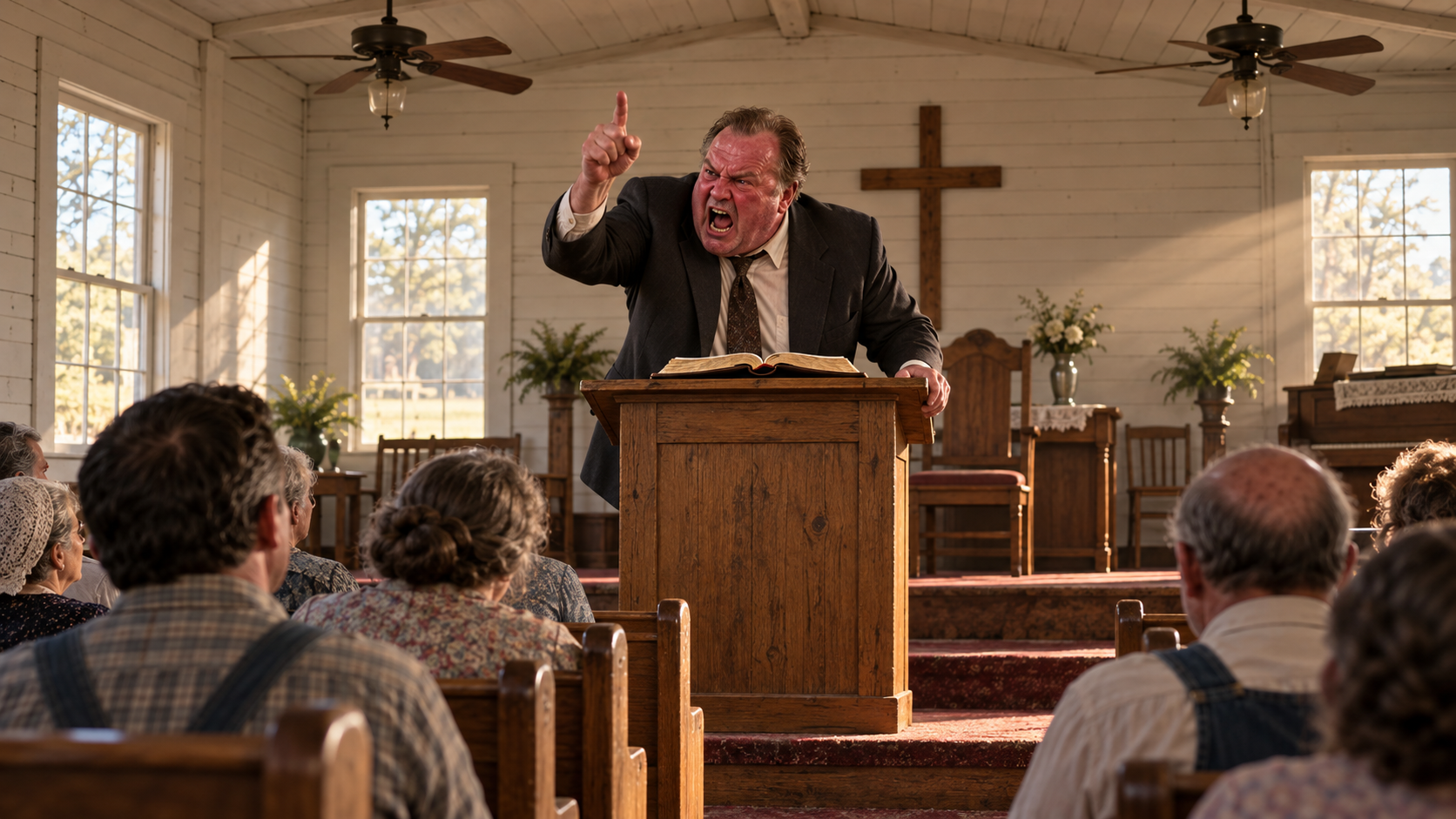
Some sentences sound like a sermon but work like a locked door. “If you really loved the truth, you’d agree with me.” “Only a rebellious heart would question this.” “I’m just telling you what the Bible says.” Each one sounds confident. Each one also makes sure the speaker can never be wrong, because disagreement has been defined in advance as a character flaw.
Let’s take a walk through the most common versions of this, because once you can name them, they lose most of their grip. Not every pastor who uses one of these is a villain. Plenty of them picked these habits up from their own teachers and never noticed. But the effect on listeners is the same either way.
1. Turning disagreement into a moral defect
This is the foundation of most of the others. The move goes like this: my interpretation equals the truth, so rejecting my interpretation equals rejecting the truth, so you must have a problem with truth.
Notice what’s been skipped. Nobody demonstrated that the interpretation is correct. The speaker simply fused himself with the text. A person can love the Bible, love Jesus, and read a passage differently than the guy at the pulpit. Christians have done exactly that for two thousand years, and the churches that preserved the early creeds did it while arguing with each other constantly.
Variations you’ll hear: “You’re resisting the Holy Spirit.” “That’s the world talking.” “Some people just don’t want to hear it.” All of them move the conversation from a legitimate theological argument to the questioner’s motives.
2. “I’m not saying this, God is”
Pastors who say this are doing something ordinary preachers do all the time, which is speaking about God. The trouble starts when the speaker’s reading of a passage gets announced as God’s own words, so that any pushback lands on God instead of on the pastor.
A healthier preacher says, “Here’s how I read this, and here’s why.” That sentence invites you to check his work. The manipulative version removes the “I” entirely, which is convenient, since you can’t argue with someone who has hidden himself behind the Almighty.
Jesus, for what it’s worth, did the opposite when he taught. He asked people questions. He told stories and let them wrestle with them. He said, “What do you think?” more often than most of his modern representatives do.
3. The unfalsifiable accusation
Some claims are built so that every possible response confirms them. “If you feel uncomfortable with this message, that’s conviction. If you feel fine with it, you’ve become hardened.” Heads I win, tails you lose.
Once a leader has set it up this way, nothing you say or feel can count against him. Your doubt proves you’re spiritually asleep. Your agreement proves he’s right. Your silence is read as agreement. That’s a trap with a Bible verse painted on it, and it can’t be called a theology.
4. Redefining questions as attacks
A good question is one of the oldest forms of faith. People in the Gospels ask Jesus hard things constantly, and he answers, sometimes sharply, but he doesn’t treat the asking itself as sin. Thomas wanted to see for himself, and he’s remembered for it more than he’s condemned.
Manipulative leaders recast the question as a threat. “Why are you being divisive?” “I’m concerned about your attitude.” “We don’t want a spirit of criticism in this church.” Notice the shift: you asked about the budget, or the theology, or a leader’s behavior, and now the topic is you.
Watch especially for the word “divisive.” Sometimes people really are stirring up trouble. But if a church uses that word every time someone raises an inconvenient fact, it has stopped being a description and become a muzzle.
5. Quoting the verse, skipping the context
Proof-texting is when someone grabs a sentence from the Bible and drops it onto your situation without asking who wrote it, to whom, and why. “Touch not the Lord’s anointed” gets used to protect pastors from accountability, though the phrase comes from a psalm about God protecting Abraham, Isaac and Jacob from harm. It says nothing about whether a modern minister may be asked where the money went.
Likewise “obey your leaders” gets lifted out of a letter written to a specific community and turned into a blanket rule. Meanwhile Jesus’ own words about leaders, that the greatest among you must be the servant and that rulers lording it over people is how the Gentiles do things, rarely get the same airtime. If a church leans heavily on obscure verses for authority and lightly on the Sermon on the Mount, ask why.
6. Appeals to fear and loss
“If you leave this church, you’re leaving God’s covering.” “People who walk away from this ministry end up in ruin.” Sometimes there’s a story attached, about the family that left and then something terrible happened. It’s usually impossible to verify and always conveniently timed.
This tactic makes leaving feel dangerous. It’s the same logic an abusive partner uses: nobody else will want you, you’ll fall apart without me. Jesus talked about the shepherd who goes after the one lost sheep. He didn’t describe a shepherd who threatens the flock about what happens beyond the fence.
Any group that depends on your fear to keep you should worry you more than the thing it’s warning you about.
7. Loaded labels for outsiders
“Liberal.” “Worldly.” “Compromised.” “Cultural Christian.” “Deconstructing.” These words get used less to describe someone than to dismiss them. Once a person has been filed under one, their arguments no longer have to be answered, only avoided.
The tell is when a label is applied to someone before anyone has engaged with what they actually said. Honest disagreement sounds like “Here’s where I think she’s wrong, and here’s why.” Manipulation sounds like “Well, you know she’s become one of them.”
8. Manufactured urgency and secrecy
“God told me we need to decide tonight.” “Don’t discuss this with people outside the church, they won’t understand.” Pressure to act quickly and keep things quiet are standard tools in every kind of manipulation, religious or not. Time to think, advice from friends and a night’s sleep are the enemies of coercion, which is exactly why coercive people try to remove them.
If a decision is truly from God, it will survive a week of consideration and a conversation with your sister.
9. The humble brag and the shield of sacrifice
“I’ve given my whole life to this church.” “I’ve been in ministry for forty years, who are you to tell me?” Experience counts for something, and long service deserves respect. But it doesn’t make a person right about the thing under discussion. Years of faithful ministry and a mistaken reading of a passage can coexist in the same man, and often do.
Related is the leader who points to the church’s size, its growth, or its “fruit” as proof of correctness. Big crowds have supported plenty of bad ideas. Jesus himself had a very small following at the end.
10. Never admitting a mistake
Perhaps the clearest sign is the simplest one: ask when your pastor last said, “I was wrong about that.” Not a vague “mistakes were made,” but a plain admission about a specific thing.
Leaders who are never wrong have usually built a system where being wrong isn’t allowed. Everyone around them has learned that correction carries a cost. A healthy leader can say “I changed my mind” without his world collapsing, and often the congregation trusts him more for it.
What a healthy alternative looks like
None of this means you should distrust every teacher or treat every firm conviction as abuse. Pastors are supposed to say things with conviction, and some conclusions are better supported than others. The difference is in how a person holds their view when it’s challenged.
A trustworthy teacher shows his reasoning. He tells you what the text says, what’s debated, and where he’s guessing. He welcomes people who disagree and doesn’t punish them. He lets you leave without drama. He can be corrected. And what he teaches tends to look recognizably like Jesus, who spent his ministry lifting burdens off people while the religious professionals of his day kept piling them on.
That last part is a good measuring stick. When Jesus criticized the religious leaders, one of his main complaints was that they tied up heavy loads and put them on other people’s shoulders without lifting a finger to help. If a church’s practices leave people more anxious, more silent and more afraid of their own questions, something has gone wrong, no matter what the sermon says.
If you recognize several of these in a church you’re in, that doesn’t automatically mean you must leave tomorrow. But it’s reasonable to start seriously thinking about whether you are spiritually free or the subject of spiritual manipulation.
Discover more from Jesus Quest
Subscribe to get the latest posts sent to your email.