
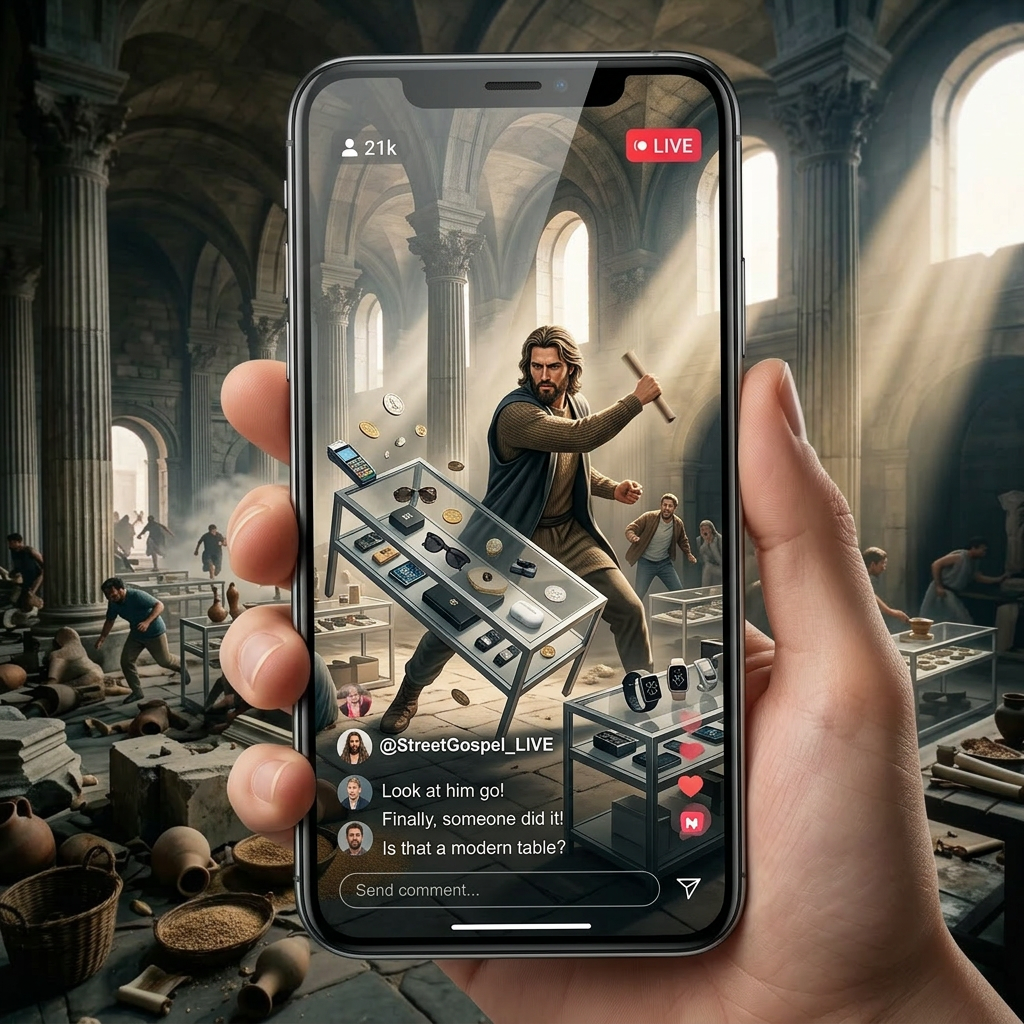
Imagine for a moment that it is not two thousand years ago in ancient Judea. Imagine instead that it is right now. Today. April 2026. And somewhere in the Middle East, something is happening.
You probably wouldn’t hear about it the way you think you would.
What We Would Hear
The first reports would trickle in through news alerts on your phone. Something about a disturbance at a religious site in Jerusalem. A man had caused a scene, overturned tables, driven out vendors who had set up shop in a sacred space. There would be footage, shaky and shot vertically on someone’s phone, already going viral before the sun went down. Commentators would weigh in before the night was over. Some would call it righteous. Some would call it dangerous. All of them would call it news.
Then would come the reports of unrest. Crowds following this man from town to town. Authorities growing nervous. Questions about permits and public safety. A few politicians making statements. The religious establishment deeply unsettled, calling for order, calling for calm, calling for this man to be brought in for questioning.
And then the healings.
That’s where it would get complicated.
Someone would post a video. A person who had not walked in years, walking. A woman weeping, saying she had been sick for so long and now she wasn’t. The comments would be immediate and merciless. Staged. Fake. Paid actor. Where’s the medical documentation? But then another video. And another testimony. And a journalist would track down one of the people who claimed to have been healed, and they would sit across from them in a studio and ask the hard questions, and the person would just keep saying, I don’t know how to explain it. I only know what happened to me.
The skeptics would have their experts. The believers would have their stories. And the whole thing would rage on social media for a news cycle or two before something else pushed it aside.
That is what we would hear.
What We Would Not Hear
Here is what would not make the news.
We would not hear about a hillside outside of town where a few thousand people sat in the grass and listened to a man speak about what it means to truly live. We would not hear the part about how the ones the world has forgotten are the ones closest to the heart of God. We would not hear about the gentle and the grieving being held in a love that the world cannot manufacture. We would not hear about mercy, about the pure in heart, about what it means to be a peacemaker in a world that rewards the fighter.
We would not hear about a conversation at a well with a woman the rest of the world had written off, a conversation so full of grace and knowing and acceptance that it changed everything for her. We would not hear about a tax collector who looked up from his booth one afternoon and found someone looking back at him not with contempt but with an invitation. We would not hear about the children being brought close, or the dinner with the people no one else would eat with, or the quiet moments when he pulled away from the crowds to pray.
None of that makes the news. None of that trends.
Controversy makes news. Love doesn’t.
The rage in the temple would be replayed ten thousand times. The sermon on the mount would be lucky to get a paragraph buried in a long-form piece that most people wouldn’t finish reading.
Only the people who were actually there would have heard the teachings. Only the ones who sat close enough, who stayed long enough, who were hungry enough to listen. Only the ones who knew him.
The Ones Who Only Heard About Him
And here is where it gets close to home.
There are many people today who have strong opinions about Jesus. Fierce ones. They invoke his name with confidence and certainty. They point to him as the justification for their anger, their politics, their posture toward the world. They have built an entire vision of him around the moment he turned over the tables, and they have decided that this is who he is. A fighter. A winner. Someone who stands against the right enemies and drives them out. Someone who judges and conquers and takes back what belongs to his people.
They believe in a Jesus who is primarily about power.
And if you ask them where they got that picture of him, if you trace it back far enough, you find that they heard it from someone else. Who heard it from someone else.
They know about the table-flipping. They do not know the Sermon on the Mount.
They know about the confrontations with the religious authorities. They do not know the conversation with the woman caught in the act of her worst moment, the one where he knelt down in the dirt and refused to condemn her.
They know the Jesus who can be recruited for a cause. They do not know the Jesus who said that the way you treat the hungry and the stranger and the imprisoned is the way you treat him.
And I say this gently, but I mean it with everything I have: if that is the Jesus you know, I wonder if you know him at all.
To Know Him Is To Hear His Voice
Because here is what happens when you actually get close. When you stop reading about him secondhand and you sit with what he actually said, what he actually did, who he actually spent his time with. Something happens to you.
You find a man who was endlessly, almost recklessly, kind. Who touched the people no one else would touch. Who told the ones the world had discarded that they were seen, known, and loved by the God who made them. Who said that the whole of everything, the entire weight of what God asks of us, comes down to love. Love for God. Love for the person in front of you. Even the difficult one. Even the one who is nothing like you. Even the one you would rather walk past.
You find a man who, in his final hours, with nails being driven through his flesh, asked forgiveness for the people doing it.
That is not a man you recruit for your rage. That is a man who undoes your rage entirely.
When you truly encounter the love of Jesus, it does not leave you looking for enemies to drive out. It leaves you looking for the person everyone else has overlooked. It leaves you softer in places you thought were supposed to be hard. It leaves you with a strange and inconvenient compassion for people you did not choose to care about.
You cannot know his love and not reflect it. It is simply not possible. It gets into you. It changes the way you see. It changes what you do with your hands and your words and your time.
Discover more from Jesus Quest
Subscribe to get the latest posts sent to your email.